This article also runs on LinkedIn.
Somewhere in the next three to five years, a couple in their seventies will walk into a dealership and buy a car because neither of them will need to drive it.
That's my prediction. My research over the past week suggests I'm on the early side. I'll show you both, and you can decide.
Start with the size of this. The Federal Highway Administration counts 54.4 million licensed drivers aged 65 and older in 2024. Of those, 4.58 million are 85 or older.
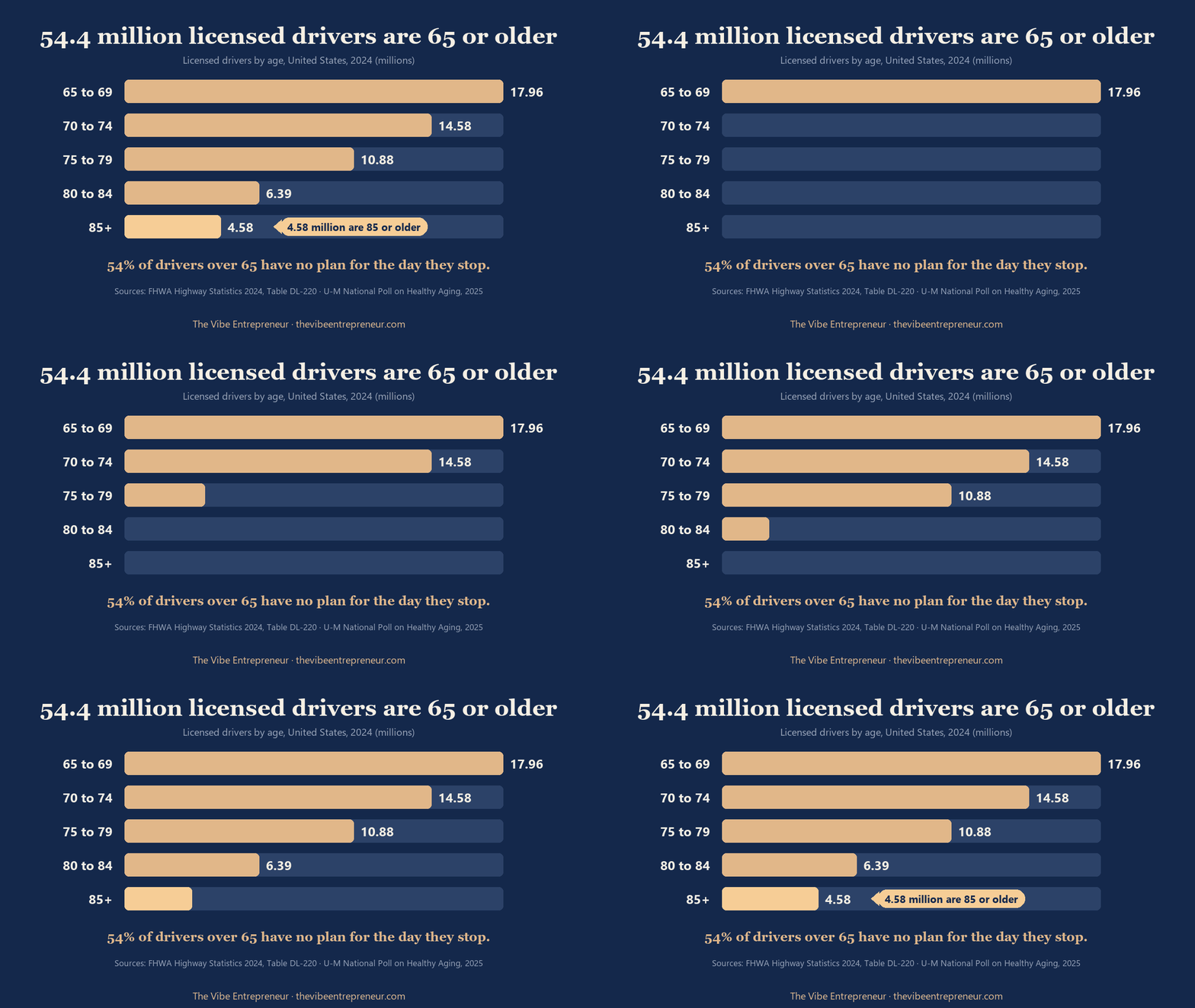
Each of them will stop driving at some point, and most haven't thought about what happens next.
The University of Michigan's National Poll on Healthy Aging found that 54% of drivers over 65 have no plan for the day they stop.
The day comes anyway. The standard study on this (Foley and colleagues, 2002, and nobody has published a newer national number) found that people who stop driving in their early seventies live another seven years without a car if they're men, and ten if they're women.
Seven to ten years of asking someone for a ride. And it costs more than convenience. A 2023 analysis of the National Health and Aging Trends Study found that people who stopped driving had 3.55 times the odds of depressive symptoms four years later. The keys are independence. When they go, a lot goes with them.
So, for this group, the self-driving car isn't a gadget story. It's the difference between staying in your own home and not.
The law is already ahead of the car
What surprised me most is that in several states, the law already allows exactly the car I'm describing.
Florida Statute 316.85, on the books since 2019, says it in plain words: "a licensed human operator is not required to operate a fully autonomous vehicle." The car can run with no one in it.
When the system is engaged, the system is the operator.
Texas and Arizona say the same thing in their own language, and Texas puts the ticket on the owner if the car breaks a traffic law.
So the legal question I thought would be the hard part is further along than the technology.
What doesn't exist yet is a car you can buy that's approved to drive that way, a federal rulebook built for a vehicle with no driver, or an insurance policy written for an owner who doesn't hold a license.
Those gaps are real. They're also the kind of gaps that get filled once there's a product to insure.
Where the car stands today
Robotaxis are the proving ground. Waymo says it's giving more than 500,000 paid rides a week in 15 metro areas. Tesla has Cybercabs running without anyone aboard in Austin, with Dallas next month.
I've seen Cybercabs on the road here in the Boston area, and others have since January. They're test cars with a wheel and pedals fitted. It's testing, not service. But they're on the road, and they're coming fast.
The owned car is a step behind, and the automakers are honest about it if you read the transcripts.
Tesla, on its October 21 earnings call, said it expects to switch on unsupervised driving in "some of the first customer vehicles" around the second quarter of 2027.
Read the next sentence too: those cars would run inside Tesla's approved areas and its fleet system, as part of the robotaxi network.
And Elon Musk said the Cybercab is mainly "transport as a service," while the cars you'd want to own are the Model 3 and Model Y.
So the last car, in Tesla's version, is a Model Y whose software has been turned loose, not a Cybercab in your driveway.
GM said the same day that its "eyes-off" highway driving will arrive on the Cadillac Escalade IQ in 2028, then spread to its pickups and big SUVs. Eyes-off still means a licensed driver in the seat who can be asked to take over.
I own a Lincoln Nautilus with BlueCruise, and I don't use it. What Tesla has built is at a different level than what GM and Ford have shipped so far.
But GM's own words for where this ends are "mission mode": the car runs errands with nobody inside. No date on that.
McKinsey asked 91 industry decision-makers in January, and they put pilots of privately owned Level 4 cars, the kind that need no supervision, in cities around 2032.
Robotaxis first, they said. Personal cars later.
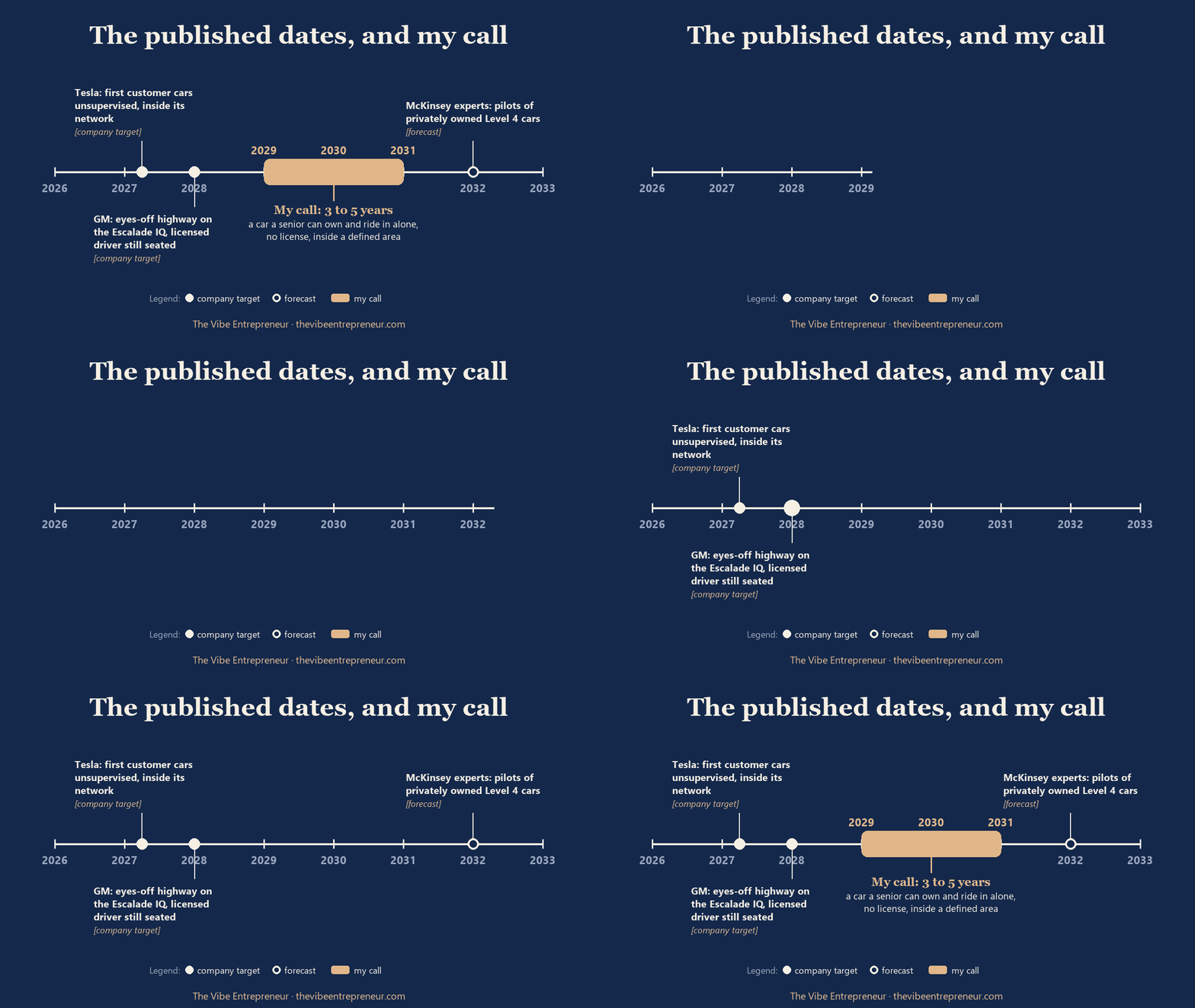
So the published timelines run from Tesla's 2027 to McKinsey's 2032. My call is three to five years for a car a senior can own and ride alone, without a license, in a defined area to start.
I think the business case pulls it forward. Fifty-four million aging drivers is the kind of market that makes companies find a way.
I may be early. I don't think I'm wrong about the direction, because every major player is pointing the same way now, and the law in Florida and Texas already got there.
What grows up around it
The car is only the first business. The services around it are where the openings are, and almost nobody is in them yet.
Think about a retirement community that owns a handful of autonomous cars and lets residents book time on them by the hour, like some communities already do with shared golf carts.
Or a company that leases a self-driving car to a household where neither spouse can drive anymore, with insurance and service built into the payment.
I looked for anyone doing either. Nobody is, yet.
Then there's everything a car can't do. It stops at the curb. It doesn't carry the groceries in, walk Mom into the clinic, or wait with her at the pharmacy. Somebody will build that layer.
Further out, home robots like Tesla's and others may take some of it. Today those are factory tools with a price tag and a date that keep moving.
We're not there yet on any of this. But the people who build it will be the ones who started looking now.
Before you buy the last car
If you or your parents are shopping for a car to age into, the sales pitch will get ahead of the product. Four questions to get answered in writing before you sign:
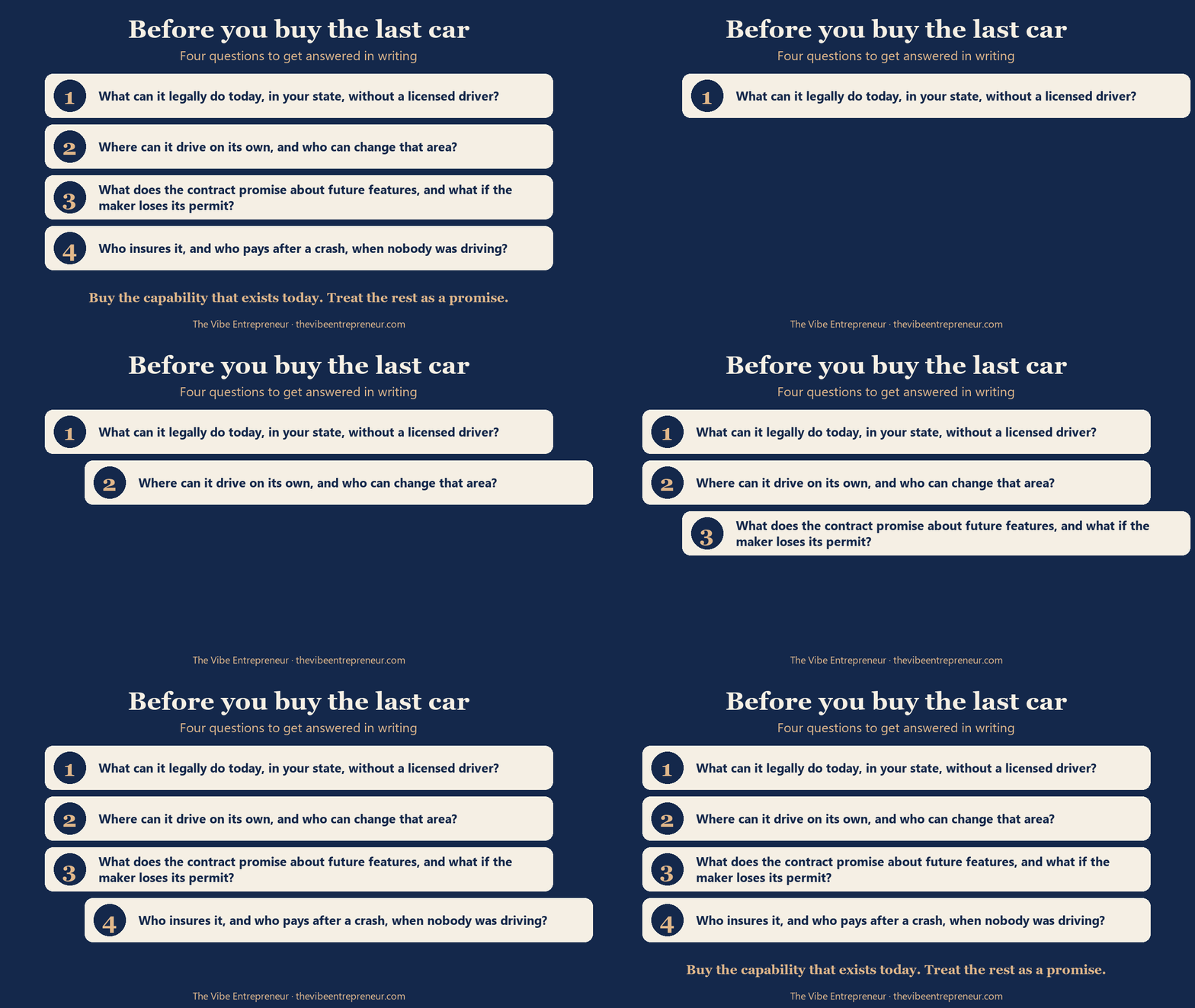
- What can it legally do today, in your state, without a licensed driver? Not what the software "will" do.
- Where can it drive on its own: which roads, which weather, how far from home, and who can change that area?
- What does the contract say about future features, and what happens if the maker loses its permit or stops supporting the software?
- Who insures it, and who pays after a crash, when nobody was driving?
Buy the capability that exists and is approved today. Treat the rest as a promise, because that's what it is.
I've watched a lot of technology arrive late and then all at once. This one has the law, the demographics, and the money all pulling in the same direction, which is rare.
So the question I'd put to you is the one I keep asking myself: if the car that drives you shows up in 2029, what business would you want to already own?
Sources for the numbers above: Federal Highway Administration, Highway Statistics 2024, Table DL-220 (Feb. 2026); University of Michigan National Poll on Healthy Aging, "The Road Ahead" (Nov. 2025); Foley et al., American Journal of Public Health (2002); "Driving Cessation and Late-Life Depressive and Anxiety Symptoms," a National Health and Aging Trends Study analysis (2023).
Law and company statements: Florida Statutes 316.85; Texas Transportation Code 545.454; Arizona Revised Statutes 28-9702; Waymo company figures (2026); Tesla's Q3 2026 earnings call transcript (Oct. 21, 2026); GM Newsroom, "GM charts a path to personal autonomy" (Oct. 21, 2026); McKinsey, "The future of the autonomous vehicles industry" (Jan. 6, 2026).